How 4pgno works
The site runs a session of four-player games for up to 200 players: euchre, pickleball, or anything played two against two, at a table, on a court or anywhere else. It is a website: there is nothing to install, and players never make an account.
Free, with no ads, ever.
- Assignment of players in each game is based on who is present and available to play. A late arrival is placed as soon as a spot is open, and anyone stepping away is left out until they are back.
- No repeat partners. Every round is calculated to keep anyone from having the same partner twice in one session.
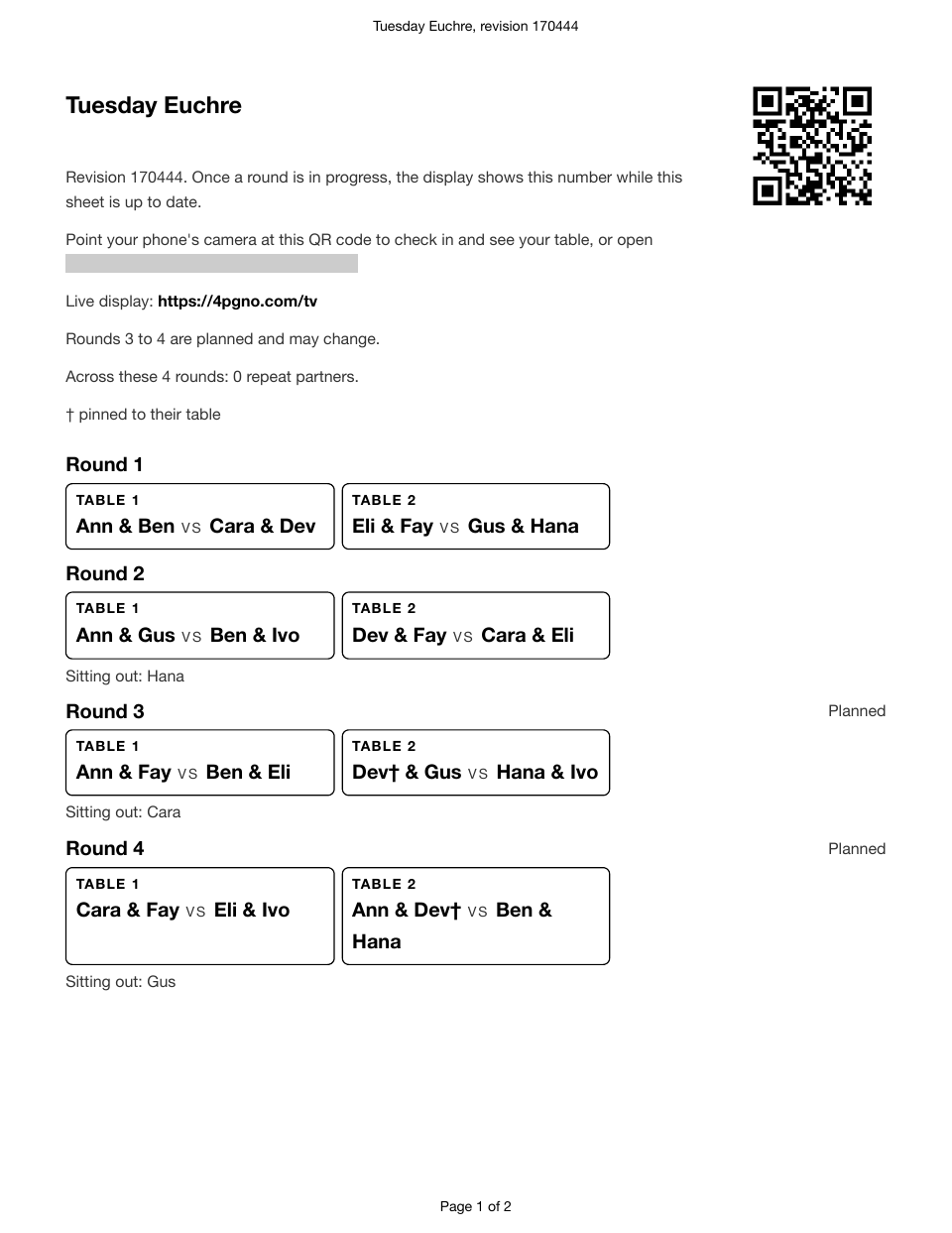
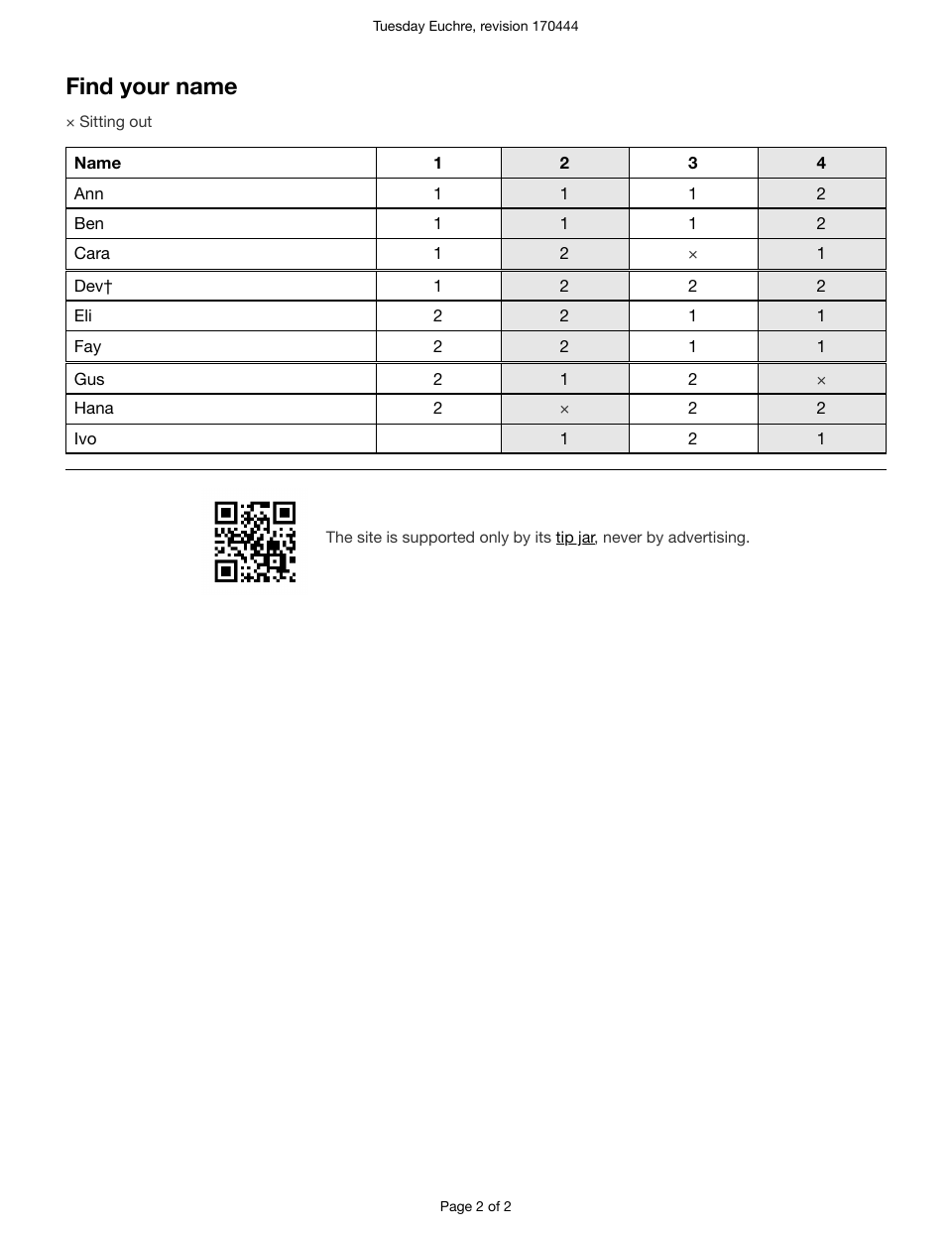
- A printed schedule, when everyone has committed. The rounds planned ahead and printed, with an index where each player finds their name.
Each player sees where to go on their own phone.
A session of euchre games
Sixteen players at a session of euchre games, shown through the organizer, two of the players and the television. The screens are pictures of the site's own pages, taken during a demonstration session.
See how the site is used in a session of euchre games
Assignment based on who is present and available
No one has to say ahead of time whether they are coming or how long they will stay. The first check-in opens round 1. Each round after that is assigned when the organizer starts it, from the people present and available at that time.
Someone who arrives late joins the round in progress if a spot is open, but otherwise will play in the next round. Someone taking a break, or leaving, taps "I'm not playing" (or the organizer marks them) and is left out of the rounds that follow until they are back.
No repeat partners
No one has the same partner twice in one session, and the site also putting anyone in a game with the same people again. A long enough session can make a repeat unavoidable; the organizer's page shows a note when that happens.
How repeat partners are avoided
When the organizer starts a round, its seating is made at that moment.
With a printed schedule, the round uses the seating made with the schedule instead, unless something has changed since then, such as who is available, the number of tables, or how an earlier round was played. Then the seating is made when the round starts.
The site builds up to eight candidate seatings of the people who play and keeps the best one, judged in this order:
- Fewest repeat partners.
- Among those with none: a new partner still possible for everyone who would play in the round after.
- Fewest pairs seated together again, first in this round, then in a projection of the next two.
When four or more people who are not pinned sit out, up to eight different groups of players are each seated this way, and the best seating of any of them is kept.
At each table, four people can be split into two teams three ways. The site picks one, avoiding repeat partners first.
A reshuffle can replace the chosen seating with a different one.
These choices involve no randomness. Two sessions with the same people can still be seated differently, for example because of:
- the order people arrive in;
- each person's ID, random when they are added, which breaks ties in the seating;
- a printed schedule's order, which is random.
Tests
Tests seat everyone every round and check that no one has a repeat partner:
- 12 players through 10 rounds
- 16 players through 14 rounds
- 24 players through 20 rounds
- 32 players through 28 rounds
- 64 players through 40 rounds
These tests must pass before any version of the site is deployed; otherwise it is considered a bug.
A schedule to print, when everyone has committed
The organizer can enter the names, plan every round and print the schedule before anyone walks in. Round 1 then starts when the organizer starts it, not at the first check-in. If the people present no longer match the plan, the remaining rounds are made from whoever is there.
Who is left out of a round
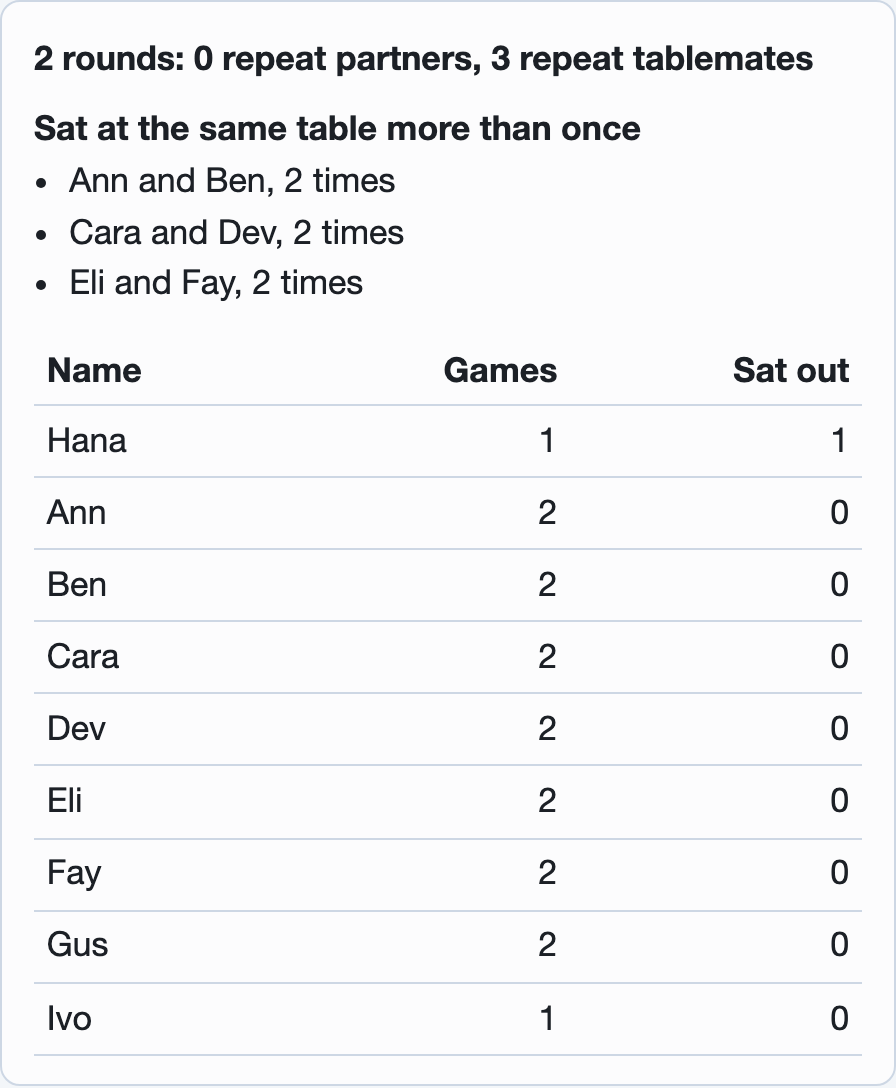
When there are more players than spots, some are left out of the round. Who plays:
- Fewer than four who are not pinned left out: those who have played the fewest games play first; among people with the same number, whoever was left out of the last round, then whoever arrived first.
- Four or more: when possible, nobody has played more than one game more than anyone else, and the site limits how many rounds in a row anyone is left out or plays.
The games it runs
- At a table: euchre, spades, pinochle, bridge, whist, bid whist, pitch, 500, canasta and dominoes. More on euchre and other table games.
- On a court: pickleball, tennis doubles, padel, badminton doubles, cornhole, bocce and shuffleboard. More on pickleball and other court games.
- Other games: table tennis doubles, petanque, horseshoes, lawn bowls, darts doubles, bowling doubles and golf two-person scramble. More on horseshoes and other games.
Joining is quick
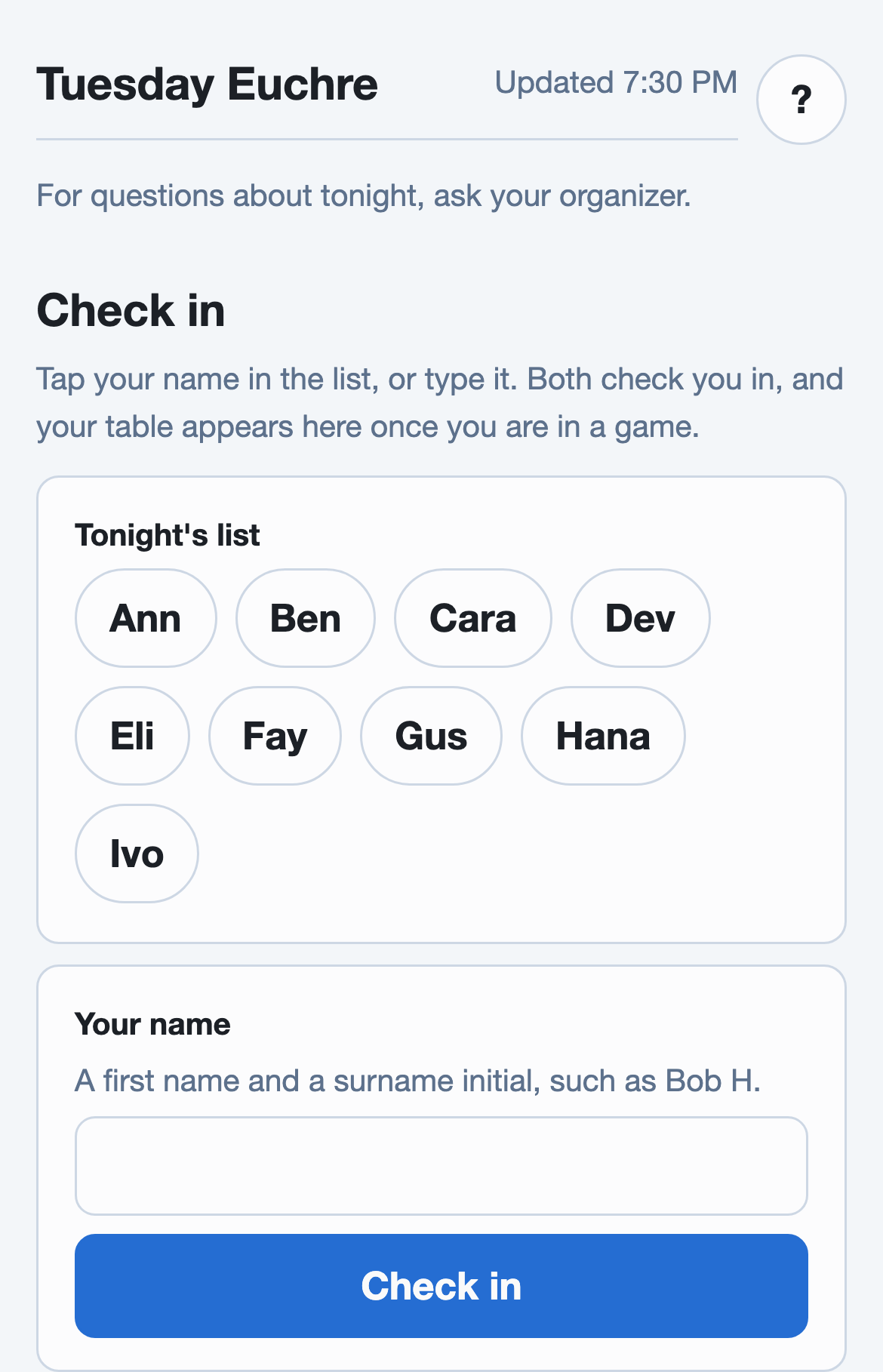
Players scan the league's QR code or open its link, then tap their name to see where to play. If the organizer did not enter their name ahead, they type it once. Their phone keeps their name until the session is reset at 5am.
Names entered ahead
The organizer can enter the names before anyone arrives, one at a time or by pasting a whole list, even a column copied from a spreadsheet. Players then find their name to tap.
Everyone knows where to go
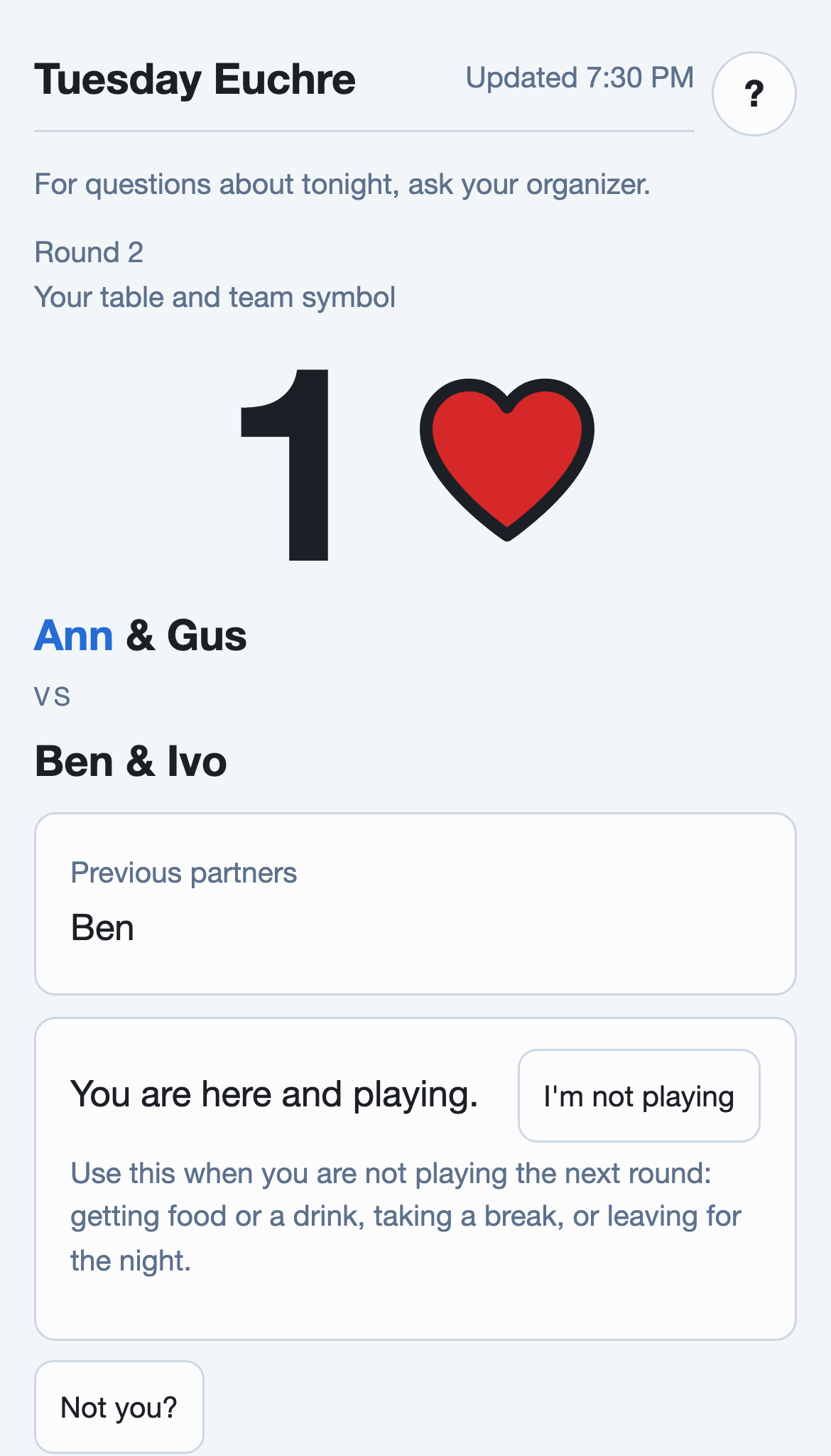
Each phone shows its player's table or court and who they are playing with and against, and updates by itself when the next round starts.
Pinning someone to a table or court
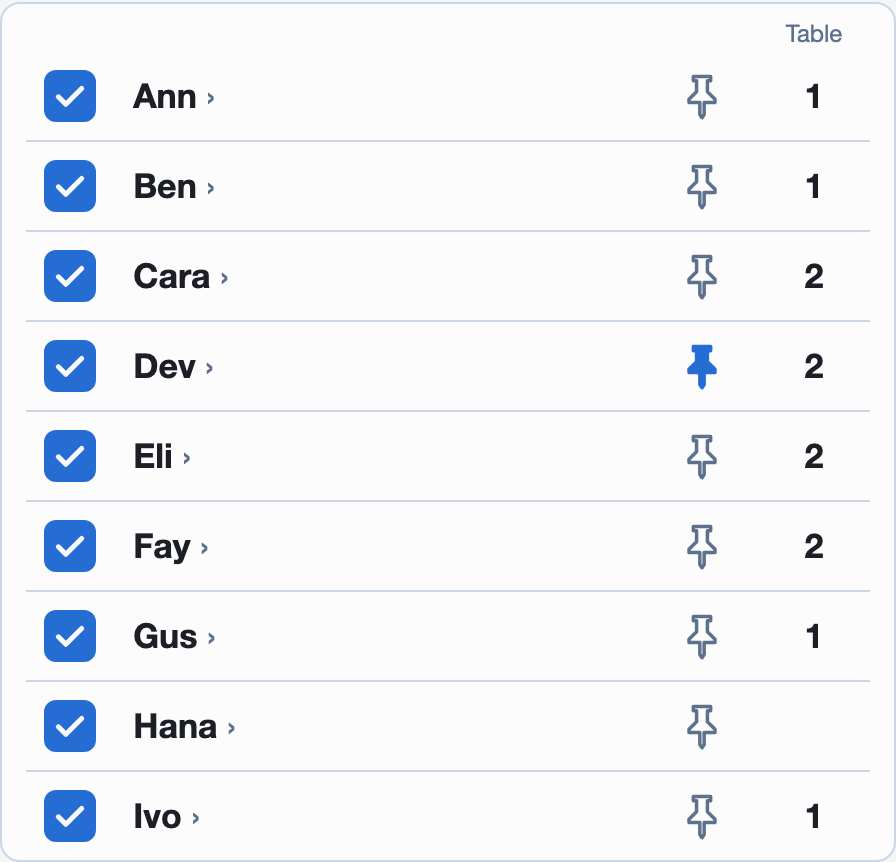
An organizer can pin a player who cannot move around easily to one table or court. While the pin is set they play there every round, and the other players change tables or courts from round to round.
A display for the room
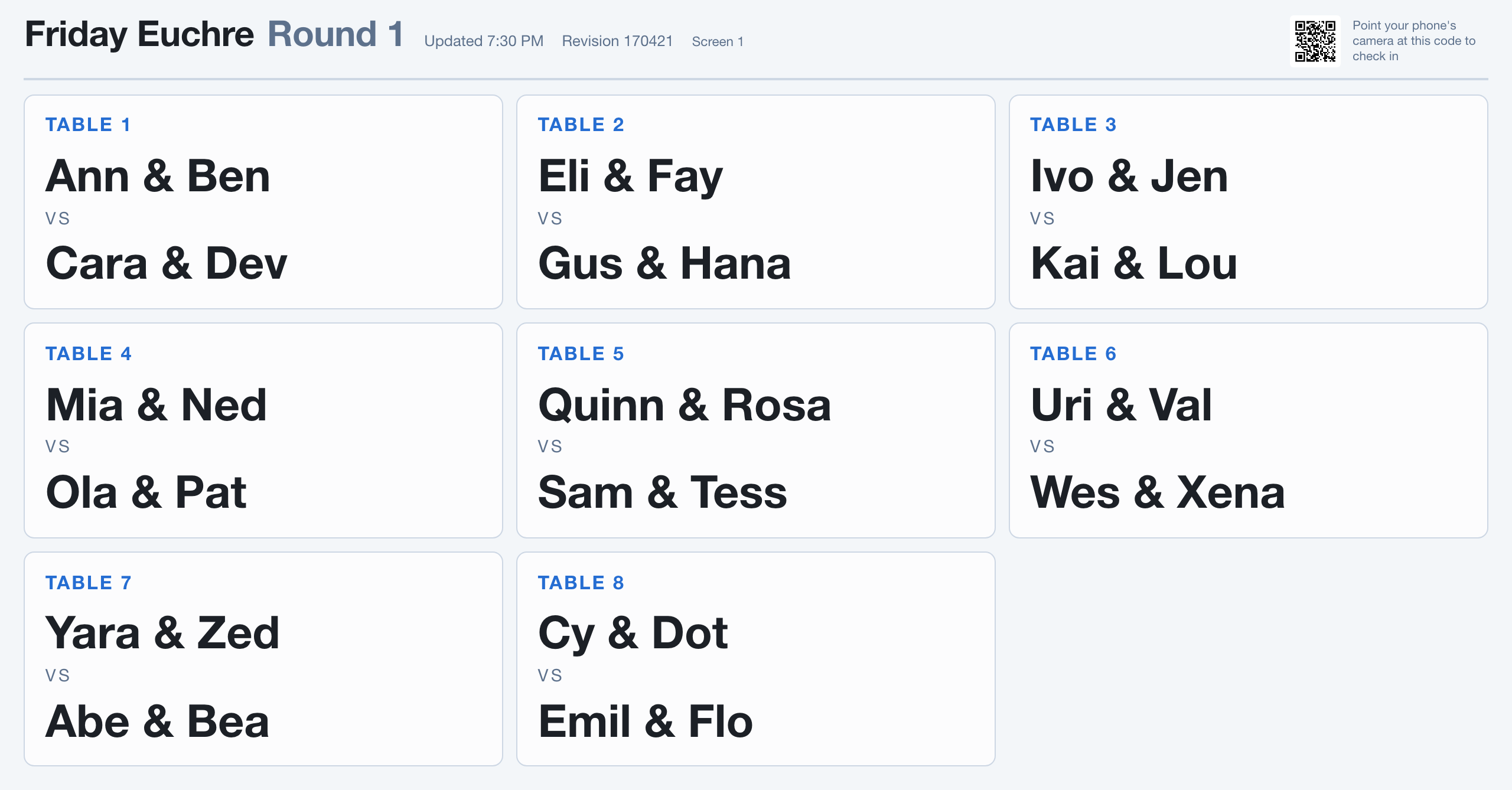
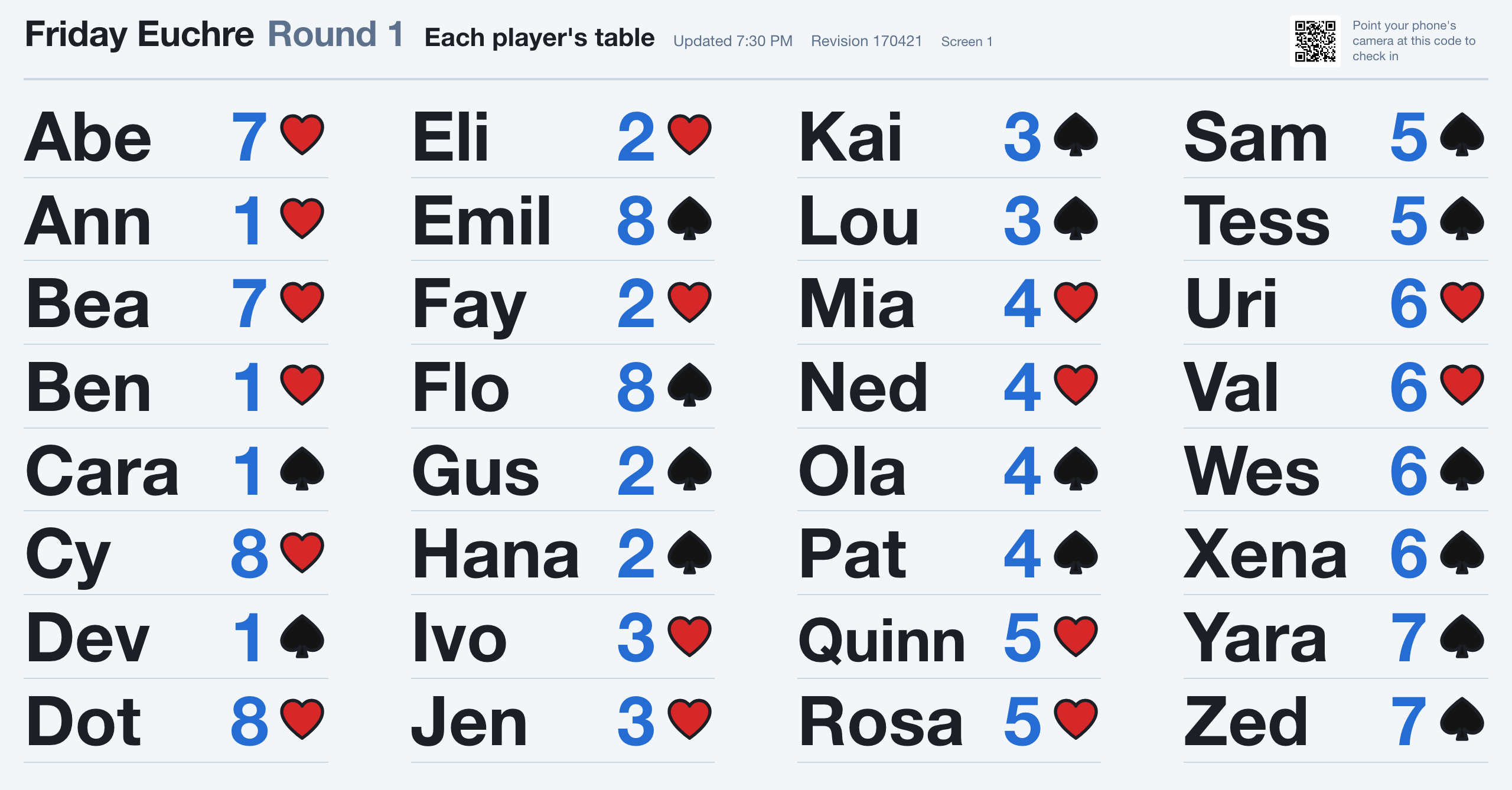
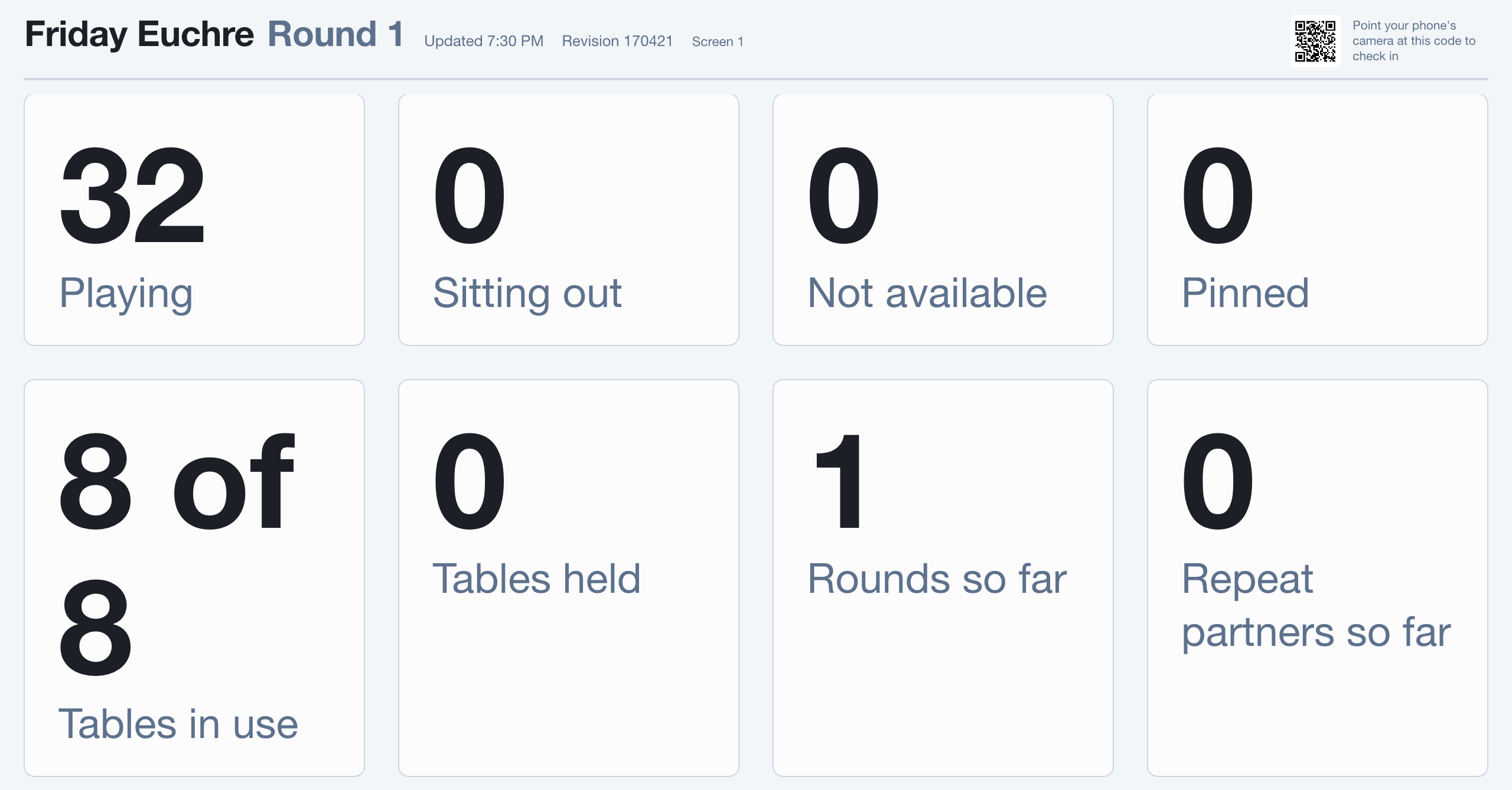
A television, or any big screen, can show who is playing where in the round in progress, large enough to read across the room. Open https://4pgno.com/tv on the television and scan its code with the organizer's phone; nothing else is typed on the television.
For organizers
- Organizers sign in with an Apple, Google or Yahoo account; no password is stored on this site.
- A one-off session can be run without signing in; it stops working at 5am. Only a league created after signing in is kept for later sessions.
- Several people can organize the same league.
- Each league uses the words of its game type: a table and seats for cards, a court for pickleball, and so on, and its own words for a night or a day.
- A round started by mistake can be undone, and a round can be reshuffled.
- The player and organizer pages have a question mark button for help. Each section of the organizer's main page and League settings also has its own question mark button, for help with that section.
4pgno is at 4pgno.com: the same name on every page, in every address and in every QR code.
Questions or ideas about the site: info@4pgno.com.